
Chapter 14
Community Engagement & Public Service
Goals
The University of Michigan stands as a model of how public institutions can deeply and positively influence the communities they serve. With a combination of teaching, research, and public service, U-M extends its impact well beyond campus boundaries, making meaningful contributions to the cultural, social, and economic well-being of Ann Arbor, Washtenaw County, and the state at large. From supporting local economies through employment and procurement to fostering vibrant civic life through cultural and educational events, U-M’s commitment to community engagement is woven into the fabric of its mission.
Overview
Education at U-M is not confined to the classroom; it is a lived experience that includes civic engagement, democratic participation, and lifelong learning. The university embraces its role in preparing students to become thoughtful, active citizens capable of engaging in civil discourse and effecting positive change. By addressing accessibility and reimagining educational models, U-M ensures that all students have the opportunity to develop the skills and values necessary for public service and leadership in a rapidly changing world.
With more than 278,000 alumni and over 51,000 employees living and working across Michigan, U-M’s influence is felt statewide. Its public service ethos is evident in its healthcare reach, economic partnerships, and broad educational initiatives that touch millions of residents each year. Its cultural activities attract hundreds of thousands of visitors to Ann Arbor each year, boosting the local economy and fostering a sense of connectedness within the campus community.
In 2024, the university announced its strategic vision for the next decade of educational leadership called Look to Michigan. One of the five core pillars of this vision is “Democracy, Civic and Global Engagement”. As democratic institutions face increasing challenges, U-M remains more committed than ever to fostering informed, engaged, and empowered communities—locally and globally—through bold leadership, inclusive dialogue, and innovative public service.
For more information
U-M Expenditures by Michigan County
U-M has a large impact on the Michigan economy, with the university directly purchasing nearly $1.4 billion in goods and services from Michigan companies in fiscal year 2024.
County,Total Spend
us-mi-001,3678
us-mi-003,3491
us-mi-005,3426708
us-mi-007,117951
us-mi-009,65825
us-mi-011,17984
us-mi-013,2557
us-mi-015,78911
us-mi-017,237278
us-mi-019,14112
us-mi-021,236929
us-mi-023,31018
us-mi-025,361807
us-mi-027,3377
us-mi-029,498252
us-mi-031,111413
us-mi-033,70553
us-mi-035,33578
us-mi-037,75472
us-mi-039,8953
us-mi-041,8278
us-mi-043,6186
us-mi-045,345314192
us-mi-047,452029
us-mi-049,18720754
us-mi-051,11596
us-mi-053,986
us-mi-055,1019408
us-mi-057,118391
us-mi-059,63702
us-mi-061,1195178
us-mi-063,25635
us-mi-065,175873291
us-mi-067,192150
us-mi-069,6248
us-mi-073,1570801
us-mi-075,7592053
us-mi-077,7007457
us-mi-079,765
us-mi-081,29574831
us-mi-085,380
us-mi-087,76920
us-mi-089,66365
us-mi-091,665355
us-mi-093,24840430
us-mi-095,467
us-mi-097,462956
us-mi-099,20860085
us-mi-101,3933
us-mi-103,172339
us-mi-105,428817
us-mi-107,305567
us-mi-109,1402
us-mi-111,259139
us-mi-113,0
us-mi-115,12410104
us-mi-117,2586
us-mi-119,49664
us-mi-121,1064608
us-mi-123,4010
us-mi-125,425284478
us-mi-127,5680
us-mi-129,26722
us-mi-131,856
us-mi-133,27330
us-mi-135,4000
us-mi-137,58126
us-mi-139,2377001
us-mi-141,1756
us-mi-143,19393
us-mi-145,1224941
us-mi-151,21603
us-mi-153,7847
us-mi-155,171373
us-mi-157,102637
us-mi-159,173841
us-mi-161,350271182
us-mi-163,550430336
us-mi-165,117710
us-mi-071,702
SOURCE: Research Universities for Michigan (RU4M) Economic Impact Study
U-M spent more than $100 million each on goods and services in five Michigan counties in FY2024: Wayne, Eaton, Oakland, Washtenaw, and Ingham. Some expenses that are not included are salaries, financial aid, and employee retirement. The majority of spending was on services (including contracts and subcontracts, payments to non-employees, insurance, rentals, etc.) and construction/maintenance. The products and services were purchased from over 39,000 Michigan-based vendors.
Public Service Expenditures, U-M and Peers
Compared to public peers, U-M spends the second most on public service, according to the most recently available IPEDS data.
,Public Service,Public Service
Wisconsin-Madison,387,
MICHIGAN,,295.9
UCLA,245.9,
UC-San Francisco,229.6,
Illinois,204.3,
UNC-Chapel Hill,200.6,
Texas-Austin,173.2,
Ohio State,172.2,
Washington,166.2,
UC-Berkeley,114.5,
Georgia Tech,81.3,
Virginia,51.5,
SOURCE: Integrated Postsecondary Education Data System (IPEDS)
Public service expenditures include expenses for activities established primarily to provide noninstructional services beneficial to individuals and groups external to the institution. Examples are conferences, institutes, general advisory services, reference bureaus, and similar services provided to particular sectors of the community. This function includes expenses for community services, cooperative extension services, and public broadcasting services.
Private university peers are excluded from this graphic because they have different reporting requirements which make it difficult to compare expenditures by category.
U-M Public Service Expenditures
The University of Michigan has increased its commitment to community engagement over time, with its public service expenditures increasing 20% compared to a decade ago.
Year,Public Service Expenditures
2015,248
2016,235
2017,236
2018,250
2019,240
2020,233
2021,296
2022,267
2023,308
2024,299
SOURCE: Integrated Postsecondary Education Data System (IPEDS)
Alumni by State
Two-thirds of U-M students who graduated in the last five years still live in-state. 42% of the 668,000 living U-M alumni live in Michigan.
State,"Number of Current, Living U of M Alumni"
us-al,1438
us-ak,644
us-az,7462
us-ar,642
us-ca,52339
us-co,11093
us-ct,5405
us-de,730
us-dc,4847
us-fl,21430
us-ga,8127
us-hi,1441
us-id,911
us-il,31711
us-in,6002
us-ia,1507
us-ks,1340
us-ky,1899
us-la,1091
us-me,1555
us-md,11281
us-ma,13014
us-mi,278095
us-mn,6198
us-ms,466
us-mo,3389
us-mt,778
us-ne,710
us-nv,2178
us-nh,1507
us-nj,11181
us-nm,2194
us-ny,30715
us-nc,9466
us-nd,200
us-oh,15411
us-ok,858
us-or,5377
us-pa,10712
us-ri,968
us-sc,3214
us-sd,298
us-tn,4391
us-tx,16313
us-ut,1917
us-vt,1187
us-va,11772
us-wa,12452
us-wv,485
us-wi,5885
us-wy,370
SOURCE: U-M Government Relations
Graduates who remain in Michigan contribute to the state’s skilled workforce across diverse sectors. Engineering graduates often join Michigan’s automotive and manufacturing industries, helping drive innovation in electric vehicles, autonomous systems, and advanced manufacturing. Business school graduates frequently take leadership roles in Michigan corporations or launch their own ventures, while medical school graduates staff the state’s hospitals and healthcare systems. Many students also stay in Ann Arbor to pursue a graduate degree.
A recent analysis by Steppingblocks, Inc., a national consulting firm, found that over 116,000 alumni currently work in Michigan, with the largest Michigan-based employers indicated as General Motors, Ford Motor Company, Michigan Medicine, Corewell Health, and the Henry Ford Health System. More broadly, our alumni are also well represented in Fortune 500 companies with Amazon, General Motors, Ford, Dow Chemical, and DTE indicated most frequently.
U-M graduates typically earn higher salaries than the state average, contributing more in income taxes and consumer spending (see Chapter 4: Undergraduate Student Success). They’re also more likely to purchase homes, start families, and become civically engaged in their communities, creating stable foundations for local economic growth.
United Way Campaign Donations
The university’s annual United Way giving campaign consistently raises more than $1 million to support health, education, and financial stability programs and services facilitated by the United Way for Southeastern Michigan.
Campaign Year,Total (in Millions)
2008,1.1
2009,1.18
2010,1.22
2011,1.33
2012,1.43
2013,1.43
2014,1.39
2015,1.37
2016,1.33
2017,1.3
2018,1.24
2019,1.27
2020,1.35
2021,1.21
2022,1.21
2023,1.14
2024,1.14
SOURCE: U-M Government Relations
According to the United Way nearly 40% of families in southeastern Michigan struggle to meet their basic needs. Each fall, the University of Michigan launches a workplace giving campaign in partnership with the United Way for Southeastern Michigan to fund local and regional programs and services to support vital community services in Washtenaw County and beyond. Donors have the flexibility to direct their funds to specific causes or to the general fund, ensuring their support has the maximum impact where it is most needed.
For more than 50 years, United Way has been the university’s sole non-profit campus-wide partner. Throughout this long standing partnership between the University of Michigan, Michigan Medicine, and United Way for Southeastern Michigan, employees have raised over $35 million dollars.
Ginsberg Center Engagement
There are many ways students engage with the community at U-M. The university’s Ginsberg Center provides many opportunities for students to prepare for civic engagement.
,Unique students,Total engagement
Workshops,1927,2197
Programs,201,1885
Outreach Events,506,506
Advising,238,783
SOURCE: U-M Ginsberg Center Annual Report
The Ginsberg Center is a community and civic engagement center with a mission to cultivate and steward equitable partnerships between communities and the University of Michigan in order to advance social change for the public good. The institute cultivates a network of community partners (nonprofits, local governments, and K-12 schools) and connects them with students, faculty, and staff who are invested in positive social change. The center’s initiatives include programs, advising sessions, grants for student organizations, and various course-based and co-curricular workshops aimed at preparing students for community engagement.
The Office of the Vice President for Student Life facilitates transformational student experiences by advancing student learning and development, fostering well-being, and cultivating an inclusive and equitable campus community. Many students also participate in Alternative Spring Break, which has small teams of students complete projects onsite at nonprofit, civic, cultural or social impact institutions outside of Ann Arbor during University of Michigan’s spring break.
Local Economic & Cultural Impact
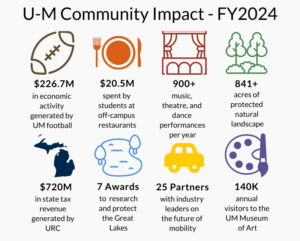
The university has a substantial economic and cultural influence on both the Ann Arbor community and the broader state of Michigan.
14.7 University Economic and Cultural Impact, FY2024
SOURCE: U-M Government Relations
The University of Michigan strives to contribute positively to the culture of Ann Arbor, Washtenaw County, and the broader state of Michigan. Every day, there are dozens of events that are free and open to the public, drawing visitors to the area. The University of Michigan Museum of Art hosted over 140,000 visitors in 2023, including 1,120 Title 1 students from 46 different K-12 schools. The U-M School of Music, Theatre & Dance has over 900 student performances per year and connects the School and its resources to the community through Youth Programs, Adult Programs and Community Outreach Programs.
The university also takes pride in its positive social and economic impact. Michigan Wolverines football games generate millions in economic activity with visitors coming from around the nation during the fall season. Ann Arbor restaurants and businesses benefit from the thousands of students who eat and shop around campus. U-M preserves 841 acres of land in the Matthaei Botanical Gardens and Nichols Arboretum, which draw over 500,000 visitors every year. The university also hosts dozens of K-12 summer camps every year to engage young students in academic and social-emotional growth, provide a chance to explore potential college majors, and offer hands-on learning experiences.
Previous Chapter
Health & Well-Being
Helping People & Communities Thrive