

Chapter 10
Budgets & Fundraising
Goals
The University budget is built to support the institution’s commitments to affordability, access, student success, and academic excellence. Strategic investments in financial aid, faculty, and research, along with prudent cost containment, are critical to these goals. Fundraising contributes to critical operational needs and strategic investments that can’t be paid from other sources. These funds become part of the university endowment.
Overview
This chapter provides details about U-M revenues and expenditures, and examines revenue trends by sources such as state appropriations, tuition, research grants and fundraising.
As a public institution, the University of Michigan relies on state support as a core part of its operating budget. While this support contributes to U-M’s ability to remain a high-performing, world-class institution, state appropriations have not kept pace with inflationary cost increases over time. This has produced a persistent and growing funding gap, leaving the University increasingly dependent on tuition and other revenue sources.
A significant portion of the university’s general fund budget is allocated toward student financial aid. The university has a long-standing commitment to meet the full demonstrated need of all resident undergraduate students. In January 2018, the U-M expanded that policy by creating the “Go Blue Guarantee,” which pledges to fund four years of tuition for in-state undergraduate students with family incomes less than $65,000 and family assets less than $50,000. Eligibility thresholds for the Go Blue Guarantee have nearly doubled since the program began. For Fall 2025 students, families earning up to $125,000 annually and holding up to $125,000 in assets qualify.
In October 2024, the university launched its most recent major fundraising campaign – Look to Michigan – with a goal of $7 billion. The seventh such campaign undertaken by U-M, Look to Michigan will raise funds to support the student experience, innovation and research, community engagement and partnerships, and building state-of-the-art facilities across the Ann Arbor, Dearborn and Flint campuses, as well as Athletics and Michigan Medicine. The generosity and commitment of donors make U-M a stronger university, opening the doors wider to students from all backgrounds and helping U-M achieve higher levels of public impact.
The university manages its endowment to meet donors’ expectations that their gifts will provide support to the university in perpetuity. The objective is to maintain and enhance the value of endowment gifts and to secure their future purchasing power.
Budget
The UM-Ann Arbor operating budget projects revenues and expenditures for four funds: General Fund, Designated Fund, Expendable Restricted Fund, and Auxiliary Activities Fund.
,Auxiliary Activities Fund,General Fund,Expendable Restricted Fund,Designated Fund
2017,5626,2641,1640,267
2018,6488,2724,1684,268
2019,6752,2814,1698,281
2020,7120,2898,1757,291
2021,6436,2815,1552,239
2022,7204,2825,1855,279
2023,7363,2897,1747,284
2024,8785,2998,1769,457
2025,9512,3050,1995,455
2026,10030,3018,1866,338
SOURCE: U-M Office of Budget and Planning
The total budget of the University of Michigan Ann Arbor, often referred to as the “All Funds budget,” is allocated to the full range of university activities, including instruction, research, administration, health care, student financial aid, student housing and athletics, among others. The revenue and expenditure budgets are divided into four main funds, which track broad campus activity groups.
The General Fund is used for operating purposes to support instruction, research, and public service; academic and other student services; operation and maintenance of the university’s physical plant; and university-funded financial aid. Revenues for the General Fund come from State of Michigan appropriations, student tuition and fees, indirect cost recovery tied to sponsored grants and contracts, and other income.
The Auxiliary Activities Fund supports a wide range of internal operations, student services, and public service activities that provide goods and services for a fee. Auxiliary units encompass Michigan Medicine’s hospitals and health centers, student housing, intercollegiate and varsity athletics, and parking services. The Auxiliary Activities Fund is the largest single source of budgeted revenue at the University of Michigan, with Michigan Medicine contributing more than 90% of the fund’s total revenue.
The Designated Fund is like the General Fund in that both support the academic mission of the university, although the Designated Fund revenue sources differ from those of the General Fund. The major sources of income in the Designated Fund are departmental revenue for continuing education (non-degree granting), conferences and seminars, royalty income, endowment distribution from unrestricted endowments, publishing of teaching and research data, unrestricted gifts (President only), and investment income from the University Investment Pool for cash held in this fund.
The Expendable Restricted Fund includes spending for research and other sponsored activities with the funds originating from the federal government, other governmental units, non-federal agencies, foundations and charitable organizations, gifts, and endowment distributions. Endowed gifts are restricted and may only be used for expenditures relating to the specific purposes as stated by the sponsor or donor.
Revenues from tuition and indirect cost recovery grew over the last decade, while revenues from state appropriations have declined, after adjusting for inflation.
,Tuition and Fees,State Appropriation,Indirect Cost Recovery,Other Revenue
2017,1900,420,308,13
2018,1977,417,317,13
2019,2061,414,327,13
2020,2128,409,348,13
2021,2083,398,323,10
2022,2108,379,328,10
2023,2179,372,337,9
2024,2256,383,348,12
2025,2286,378,371,14
2026,2332,365,306,14
SOURCE: U-M Office of Budget and Planning
Revenues grew over the last decade from tuition and indirect cost recovery, helping to offset declining state appropriations. Tuition growth has stemmed primarily from enrollment growth and increases in out-of-state and graduate program rates, while indirect costs increase as externally funded research grows. A sizable portion of revenues gained by tuition increases goes to financial aid to assist students with need.
The state appropriation values in the table reflect the estimated funding level that was included in the U-M budget approved by the Regents.
Indirect costs (IDC) in research are the costs of university operations that support the research enterprise, but which cannot be assigned to a particular project. Examples include the costs for general research administration, utilities used in research space, and administrative support such as finance and libraries. The indirect cost recovery rates provided by non-federal sponsors, such as foundations, State of Michigan agencies, and private companies, vary according to the sponsor’s policies or through negotiations with the sponsor. In such situations, the recovery rate may not fully cover the actual expenses incurred by the U-M to support some of these projects.
Two-thirds of the U-M’s annual General Fund budget directly supports academic activities.
,Percent
Academic Activities,65.50
Financial Aid,13.60
Facilities and Risk Management,10.70
Administrative Services,10.20
SOURCE: U-M Office of Budget and Planning
65.5 cents of each dollar for academic activities: Instruction, Academic Advising, Libraries, Museums.
13.6 cents for centrally awarded financial aid.
10.7 cents for facilities and risk management: Plant Operations, Utilities, Insurance, Public Safety, Compliance.
10.2 cents for administrative services: Admissions, Budgeting and Accounting, Central Human Resources, Central Information Technology, Legal Services.
Expenditures in school/college support, executive officer and service units, and financial aid make up the majority of general fund budgeted expenditures.
,Schools and Colleges,Executive Officer and Service Units,Financial Aid,University Items,Academic Program Support,University Academic Units,Capital Renewal Fund,Departmental Activities,Research Units
2017,1499,379,289,183,118,94,65,10,5
2018,1550,387,307,179,127,95,65,10,4
2019,1616,390,338,179,111,98,64,11,7
2020,1671,396,360,178,109,100,64,12,8
2021,1569,386,368,181,134,97,63,8,7
2022,1614,392,372,175,102,95,62,8,7
2023,1710,396,372,175,77,92,61,8,8
2024,1759,399,396,185,90,92,60,10,6
2025,1768,419,405,186,99,93,60,12,6
2026,1702,431,409,201,103,97,60,13,4
SOURCE: U-M Office of Budget and Planning
Expenditures in financial aid, school/college support, research units, and executive officer and service units grew over the last decade.
The University Items category includes general university support, utilities, insurance, North Campus Research Complex facilities costs, legal and professional fees, graduation ceremonies and presidential events, and unemployment compensation benefits.
Cost Containment
U-M administrative expenses are lower than the majority of peer institutions. This is the result of aggressive cost containment for more than a decade, driving out significant recurring costs.
,Admin costs per FTE Enrollment,Admin costs per FTE Enrollment
U-M,10452,
Peers,,14137
SOURCE: Integrated Postsecondary Education Data System (IPEDS)
Administrative Costs are defined as institutional support by IPEDS and include general administrative services, central executive-level management & planning, legal & fiscal operations, space management, employee personnel & records, purchasing & printing, and public relations & development. Also includes IT expenses related to institutional support activities.
State Appropriations, Tuition & Fees, and Other Revenues
The state appropriation’s share of the General Fund has declined dramatically since 1970.
,"State
Appropriation",Tuition and Required Fees,Indirect Cost Recovery and Other Revenue
1970,64,26,11
1971,62,27,11
1972,61,29,10
1973,62,28,9
1974,64,28,9
1975,63,28,8
1976,62,30,8
1977,60,31,9
1978,60,31,8
1979,61,31,8
1980,61,31,9
1981,58,33,9
1982,53,38,10
1983,50,41,9
1984,51,41,8
1985,52,40,8
1986,52,40,7
1987,53,40,7
1988,51,41,8
1989,48,43,9
1990,46,44,10
1991,45,45,10
1992,44,46,10
1993,42,49,8
1994,40,51,10
1995,39,52,9
1996,37,53,9
1997,38,53,9
1998,37,51,11
1999,36,52,12
2000,36,52,12
2001,36,51,12
2002,35,52,13
2003,33,54,13
2004,29,57,14
2005,28,58,14
2006,26,59,15
2007,25,60,15
2008,24,62,14
2009,23,63,13
2010,22,65,13
2011,20,65,14
2012,17,69,14
2013,17,70,13
2014,16,71,13
2015,16,71,12
2016,16,71,12
2017,16,72,12
2018,15,73,12
2019,15,73,12
2020,14,73,12
2021,14,74,12
2022,13,75,12
2023,13,75,12
2024,13,75,12
2025,12,75,13
2026,12,77,11
SOURCE: U-M Office of Budget and Planning
In FY1970, the State appropriation represented 64 percent of the Ann Arbor campus General Fund budget. By contrast, tuition and required fees for FY2026 are 77 percent of the General Fund; in FY1970, tuition was 26 percent of the General Fund. The crossover year was FY1991, when the State appropriation and tuition each provided 45 percent of the General Fund budgeted revenues. Constrained state resources, along with policy changes that have increased appropriations for direct scholarship support to Michigan students, have resulted in state operating appropriations that have increased significantly less than the rate of inflation. As a result, a larger portion of institutional costs is supported through tuition revenue and institutional financial aid rather than state operating funds.
The U-M’s General Fund budget for FY2026 projected a State of Michigan appropriation of $365.5 million. The U-M’s budget projection may vary slightly from the actual State of Michigan appropriation received in a given year because the university fiscal year starts three months earlier than the State’s, which can result in appropriation amounts that are unfinalized at the time of university budget adoption.
State Support Gap
The gap between the purchasing power for the FY2002 state appropriation projected to FY2026 and enacted appropriations has grown to $353 million.
, FY2002 Appropriation Projected at Change in ECI, Enacted State Appropriations
2002,363.6,363.6
2003,376.5,363.6
2004,391.0,327.2
2005,405.0,320.7
2006,417.0,314.7
2007,431.0,325.8
2008,445.1,320.2
2009,455.5,326.7
2010,462.9,316.6
2011,472.3,315.1
2012,481.4,268.8
2013,490.5,273.1
2014,499.9,279.2
2015,511.1,295.2
2016,521.6,299.4
2017,533.7,308.6
2018,547.8,314.6
2019,563.2,320.8
2020,578.7,322.8
2021,593.8,335.6
2022,619.7,326.3
2023,649.8,339.2
2024,677.1,356.6
2025,702.2,365.7
2026,726.7,373.4
SOURCE: U-M Office of Budget and Planning
In this chart, the blue line represents what the state appropriation would be if the state had matched the change in support to the rate of inflation. The red line shows the actual enacted appropriation.
In nominal dollars, the state appropriation for the Ann Arbor campus initially peaked at $364 million and decreased in subsequent years, finally returning to a similar level in FY2025. Factoring in inflation, the 2026 budgeted state appropriation for the Ann Arbor campus needed to be $726.2 million to equal the purchasing power of the 2002 appropriation, a gap of $353 million.
State Support per Student
Most public peer universities receive more state support per student than the University of Michigan-Ann Arbor.
,Appropriation per FTE Student,Appropriation per FTE Student
UNC-Chapel Hill,20308,
Texas-Austin,16156,
Georgia Tech,14339,
UC-Berkeley,12298,
UCLA,11491,
Washington,11073,
Wisconsin,10173,
Virginia,9887,
Ohio State,8785,
MICHIGAN,,6834
Illinois,5666,
SOURCE: Integrated Postsecondary Education Data System (IPEDS)
The calculation of full-time equivalent (FTE) students for each school is based on IPEDS methodology. Note: These values are not adjusted for inflation, so the U-M value above does not match the FY2023 inflation-adjusted value shown in other charts.
Gifts
Private gifts are an essential source of revenue that supports academic activities and student financial aid.
,Privates gifts
2016,225
2017,209
2018,252
2019,222
2020,217
2021,218
2022,248
2023,209
2024,259
2025,280
SOURCE: U-M Financial Statement
This chart shows the total private gifts to the University of Michigan for operational activities. Other private gifts not included in the chart are those intended for permanent endowment purposes or capital gifts supporting initiatives in, for example, the health system, UMCI, Ross School of Business, College of Engineering or Intercollegiate Athletics.
Endowment
The university’s investment strategy and spending rule aim to provide funds for the present, while ensuring growth that protects spending power in the future.
,Billions of Dollars
2016,13.1
2017,14.4
2018,15.3
2019,15.5
2020,15.6
2021,20.1
2022,19.7
2023,19.3
2024,19.9
2025,21.2
SOURCE: NACUBO Commonfund Study of Endowments
The University of Michigan’s endowment plays an essential role in sustaining academic quality. Endowment funds are invested for the long-term, and earnings from those investments provide a guaranteed source of income to support in perpetuity (named) professorships, student scholarships, and innovative programs and learning opportunities. Donors who contribute to the endowment do so because they want to support the university and positively impact U-M students and academic programs now and in the future.
The endowment is essential because, in times of both economic growth and contraction, it provides a guaranteed source of income to support the university’s mission and priorities. The endowment spending rule sets the annual distribution rate at 4.5% of the one-quarter lagged seven-year moving average of the fair value of shares held in the University Endowment Fund.
The U-M investment goal for the endowment is to grow faster than the rate of inflation; this protects the spending power of the proceeds, providing funds for the present and the future. In addition, annual growth in endowment earnings allows the university to maintain its activities and student experiences while minimizing tuition and fees increases.
The growth in endowment value from FY2020 to FY2021 is primarily due to the significant increase in the value of the stock market, as opposed to growth in endowment contributions. The change in endowment value from FY2021 to FY2022 is primarily due to the significant increase in the inflation rate.
The U-M has the largest endowment among its public university peers.
,Total Endowment,Total Endowment
Harvard,52,
Yale,41.4,
Stanford,37.6,
Princeton,34.1,
MIT,24.6,
Penn,22.3,
MICHIGAN,,19.2
Columbia,14.8,
Northwestern,14.2,
Johns Hopkins,13.1,
Washington-St. Louis,12,
Duke,11.9,
Emory,11,
Cornell,10.7,
Virginia,10.2,
Chicago,10.1,
Ohio State,7.9,
UNC-Chapel Hill,5.7,
Wisconsin-Madison,4.3,
Carnegie Mellon,4,
Georgia Tech,3.2,
UC-Berkeley,3.1,
UC-San Francisco,2.9,
SOURCE: 2024 NACUBO Commonfund Study of Endowments. UT Austin is excluded because the study cites a figure for the entire UT system.
The U-M endowment market value in FY2024 increased by $1.8 B compared to FY2023. The value of North American college and university endowment funds increased an average of 9.7 percent between FY2023 and FY2024, according to an annual survey of 669 institutions and higher education foundations by TIAA and the National Association of College and University Business Officers (NACUBO).
The change in market value does not represent the rate of return for the institution’s investments. Rather, the change in the market value of an endowment from one fiscal year to the next reflects the net impact of withdrawals to fund institutional operations and capital expenses, the payment of endowment management and investment fees, additions from donor gifts and other contributions, and investment gains or losses.
U-M has a large enrollment compared to its private peers, so it ranks among the lowest endowment per full-time equivalent student in its peer group.
,Endowment per FTE (in thousands),Endowment per FTE (in thousands)
Princeton,3751,
Yale,2714,
Stanford,2135,
Harvard,2134,
MIT,2087,
UC-San Francisco,939,
Penn,875,
Washington-St. Louis,798,
Emory,728,
Duke,706,
Northwestern,686,
Johns Hopkins,594,
Chicago,591,
Columbia,478,
Virginia,409,
Cornell,385,
MICHIGAN,,310
Carnegie Mellon,256,
UNC-Chapel Hill,190,
Ohio State,133,
Georgia Tech,97,
Wisconsin-Madison,92,
UC-Berkeley,72,
SOURCE: 2024 NACUBO Commonfund Study of Endowments; Integrated Postsecondary Education Data System (IPEDS)
According to the 2024 NACUBO Commonfund Study of Endowments, the majority of endowment spending benefits students, with 48.1 percent funding student financial aid and 17.7 percent being distributed to academic programs.
U-M’s endowment-to-enrollment ratio is higher than the national average but lower than the average of its benchmarking peers.
10.7.4 Total Endowment vs FTE Enrollment, U-M and Peers, FY2024
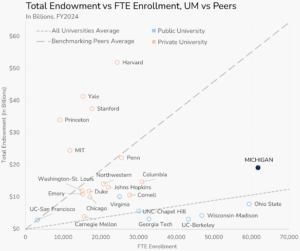
SOURCE: 2024 NACUBO Commonfund Study of Endowments; Integrated Postsecondary Education Data System (IPEDS)
U-M has a higher enrollment and endowment than any of its public peers, and a much higher enrollment than any private peers.
Previous Chapter
Research & Technology Transfer
Translating Discoveries into Real-World Impact
Next Chapter
Space & Sustainability
Supporting the University’s Missions & the Environment